CubeCrafter
- 4.4
- Rating
- 10.00M
- Installs
- Free
- Price

 Analysis by App-foxy
CubeCrafter is a free role-playing game from SayGames Ltd that turns gathering and building into a compact mobile routine. I spent time with it as the kind of game you open for a short break, collect a few block-shaped resources, improve your surroundings, and close before the session becomes a commitment. Its appeal is easy to understand: the world grows through small actions, and each new structure gives your next visit a visible purpose.
What makes it worth considering is not a complicated story or a deep character system. It is the steady feeling of turning raw materials into something more organized and personal. The experience sits closer to a relaxed crafting game than to a traditional role-playing adventure, so expectations matter. If you want a demanding combat RPG with detailed party management, this is probably the wrong direction. If you like simple progression, visual construction, and a game that explains itself through play, it has a pleasant rhythm.
How the crafting loop feels after several sessions
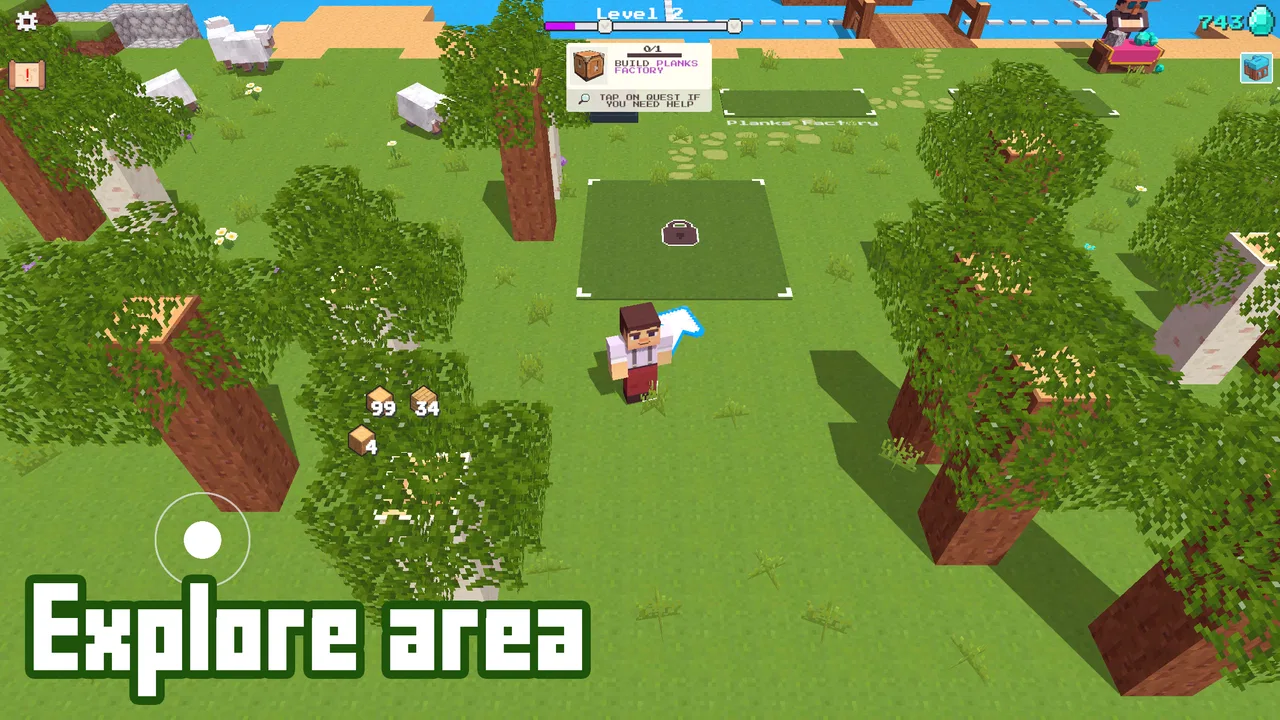
The central routine is straightforward: move through the world, gather resources, and use them to create structures. That simplicity is one of the strongest parts of the design because I rarely felt lost about what to do next. The next construction goal gives the session a practical focus, while the changing shape of the built environment makes progress easier to notice than a number quietly increasing on a menu.
You May Also Like

 Blood Strike: 2.5 Anniversary
Blood Strike’s Loadouts Turn Every Drop Into a Tactical Gamble
A close look at Blood Strike’s custom loadouts: how fast access to signature weapons reshapes its battle royale rhythm, rewards preparation, and narrows the gap between fights.

 Pandora - Music & Podcasts
Pandora’s Music Is Easy to Start, but Harder to Recover
Pandora’s strength is its low-effort path from a seed to a station. Its weak spot is how much confidence it asks you to place in connection, setup, and quiet recovery.

 8 Ball Pool
 Is Built on Rivalries, Rematches, and Routine
A close look at the rivalries, rematches, shared routines, and unanswered safety questions that turn a quick pool match into a persistent mobile community.

 Samsung Music
’s Quiet Strength Is Playing What You Already Own
Its reach comes less from spectacle than from dependable access to a personal library. That simplicity is both the app’s strongest retention engine and its ceiling.

 AccuWeather: Weather Radar
AccuWeather Review: A Quick, Clear Forecast for Everyday Decisions
For everyday plans, the best forecast is the one you can understand quickly. AccuWeather makes rain timing, radar, and local conditions easy to act on, with a few trade-offs.

 Hill Climb Racing
Why Hill Climb Racing Still Turns Crashes Into One More Run
A tiny car, a bumpy hill and one more upgrade: Hill Climb Racing keeps resurfacing because its simple chaos makes every near-miss feel personal.
More From Our News Desk
View All News


I found the best way to play was to treat each visit as a small work cycle rather than trying to finish everything at once. I would begin by checking what the next structure required, collect materials with that target in mind, and then return to crafting instead of gathering randomly. This approach reduced the feeling of wandering and made limited playtime feel productive. It is a useful habit for anyone playing during a commute, a lunch break, or while waiting for an appointment.
The block-based presentation also gives the game its identity. Resources and structures feel like parts of the same visual language, so the world communicates its purpose without needing long explanations. That does not make the mechanics deep by itself, but it does make the basic loop readable. I could usually understand why I was collecting something and what kind of progress it supported.
There is a subtle trade-off here. The game’s accessibility comes from keeping decisions light, but players who enjoy complex crafting trees may eventually want more control than this format provides. The pleasure is in the repeated transformation from gathered material to a visible improvement, not in designing an elaborate production network. I would recommend it to someone who enjoys a calm sense of accumulation, while warning strategy-heavy players that the simplicity is intentional.
What progress feels like in everyday play
A realistic session might look like this: I open the game with only a few minutes available, collect the nearby materials connected to my current objective, and spend them on one improvement. Even when the session is short, I leave with a clear result rather than an unfinished battle or a complicated quest log. That makes CubeCrafter particularly suitable for people who prefer games that respect interrupted attention.
For longer sessions, I would avoid gathering without a plan. The most useful practical tip is to decide whether I am playing for immediate construction or simply stocking up. Mixing those goals can make the loop feel slower because resources disappear into several small actions without producing a satisfying landmark. Focusing on one build at a time creates stronger feedback and helps reveal whether the current progression pace suits me.
Another useful habit is to pause after completing a structure and reassess the next requirement instead of automatically continuing in the same direction. In a resource-focused game, that small reset matters: it prevents me from spending materials impulsively and gives the next collection run a purpose. This is not a hidden shortcut, but it is the kind of workflow that makes the simple mechanics feel more deliberate.
The role-playing label should also be understood in context. CubeCrafter uses the satisfaction of improving a world and moving through a progression path, but it is not the same proposition as a story-led RPG, a tactical role-playing game, or a large sandbox with unrestricted building. I see it as a lighter interpretation of the category, designed around gathering and construction rather than character drama or difficult encounters.
Where spending enters the experience
The game is free to download and play, with optional in-app purchases listed from $1.99 to $29.99 per item. That range is important for anyone deciding whether the experience fits their budget. I can approach the game without paying at the start, but the presence of purchases means I would keep an eye on how much convenience or acceleration matters to my own play style.
I would not describe the purchase structure as automatically unfair simply because paid items exist. The responsible question is whether I still enjoy the basic gathering-and-building loop without treating payment as an obligation. For me, the right approach is to play normally first, learn how the progression feels, and only then decide whether an optional purchase adds genuine enjoyment. Buying before understanding the rhythm can turn a relaxed game into a spending decision.
Families should pay attention to the purchase range even though the content rating is Everyone. An age rating describes the type of content, not whether every player will make sensible purchase choices. On a shared device, I would use the platform’s purchase protections and talk with younger players about what paid items mean before handing over access. That is practical advice rather than a criticism of the game itself.
The developer, SayGames Ltd, has positioned this as an accessible mobile experience, and the broad audience response supports that impression: it has an average rating of 4.5 from around 121 thousand ratings, with more than 10 million installs. Those figures suggest that the basic idea connects with many players, although popularity cannot tell me whether the spending balance will feel comfortable for a particular person. I still judge that by the moment-to-moment loop.
Does paying change the sense of achievement?
This is where I would be most careful. The purchase information establishes the available price range, but it does not by itself explain exactly how every item affects progression. I would not promise that spending is irrelevant, and I would not claim that payment is required. The fair conclusion is narrower: the game is free to start, optional purchases are present, and each player should decide whether the non-paying pace remains enjoyable before spending.
That uncertainty changes how I would recommend it. A player who enjoys earning every structure through repeated gathering may prefer to delay purchases and see how far the ordinary loop carries them. Someone who mainly wants a quick building break may be more comfortable paying for convenience if an offered item clearly saves time without becoming the entire reason to play. In both cases, setting a personal limit beforehand is wiser than making several small decisions during a moment of frustration.
I also think the game works best when I measure progress by completed structures rather than by how quickly I can move through it. Chasing speed can make any resource game feel like a queue. Taking the slower route preserves the satisfying part: I collected something, made a choice, and changed the world. If a purchase would remove that sequence rather than support it, I would skip it.
Fairness when there is no competitive pressure
CubeCrafter does not present itself to me as a game where I need to defeat other players to prove progress. That matters for fairness. In a competitive role-playing game, purchases can raise difficult questions about power, rankings, and whether a paying player has an advantage over someone who does not spend. Here, my experience is centered on personal construction and resource gathering, so the main fairness test is different: does the free route remain satisfying, and does spending feel optional rather than necessary?
I would choose this game over a competitive alternative when I want to avoid performance pressure. There is no need for me to coordinate with a team, maintain a ranking position, or keep pace with opponents. The result is a more private kind of progression. I can play carefully, stop whenever I want, and return without feeling that I have failed a group.
That does not mean every player will find the pace equally fair. A person who expects immediate access to every structure may see ordinary gathering as a barrier, while someone who likes gradual improvement may see the same pace as the point of the game. The important distinction is whether I enjoy the activity itself. If collecting feels like busywork from the beginning, purchasing convenience is unlikely to fix the deeper mismatch.
Compared with a traditional sandbox game, CubeCrafter offers a more guided experience. I get a clearer progression path, but I give up some of the freedom that comes from inventing my own goals. Compared with an idle or automation-focused game, it asks me to participate more directly in gathering and construction. Compared with a combat RPG, it replaces battles and equipment decisions with a gentler resource loop. Those differences make it easier to choose, but they also show exactly who may be disappointed.
Device expectations and practical fit
The current version is 1.17.13, and the game requires Android 8.0 or later. For an Android player, that makes checking the operating system the first practical step before downloading. I would also leave enough storage and keep the device reasonably updated, not because the game demands a particular setup, but because mobile games are more pleasant when installation and updates are not competing with a nearly full phone.
CubeCrafter is free, rated Everyone, and released on August 4, 2022. Those details place it as an established casual mobile game rather than a brand-new experiment. The large install figure and substantial review activity make it easier to see as a known option in the category, but I would still test it personally because the central question is subjective: do I enjoy repeating the gathering-to-building cycle?
One strength is that the game can fit around an irregular schedule. I do not need to reserve an evening for it to get something done. One limitation is that the same compact loop may feel repetitive if I need constant novelty, a strong narrative, or increasingly complex decisions. I would skip it if my ideal mobile RPG involves dialogue choices, elaborate character builds, or tactical combat. I would also skip it if I dislike any game that includes optional purchases, even when the download itself is free.
Questions I would settle before installing
If I am wondering whether it is suitable for a child, the Everyone rating indicates broadly accessible content, but I would still handle purchases separately. The age label does not remove the need for sensible device controls, especially when a game offers individual items in a range that reaches $29.99.
If I am asking whether I must pay to begin, I do not: the game is free. The more useful question is whether I will enjoy the free progression before considering extras. I would play enough to understand the normal resource rhythm, then decide. That keeps the purchase choice based on experience rather than curiosity.
If I want a deep RPG, I would compare the game with my actual priorities. CubeCrafter is a better fit for gathering, crafting, and visible world improvement than for story or tactical depth. If I want a competitive game, I would choose something designed around direct multiplayer competition instead. This one is strongest when progress is personal and low-pressure.
If I am unsure whether short sessions work, my answer is yes, provided I choose one construction goal at a time. The game’s structure makes small visits meaningful, while longer sessions are available for players who enjoy repeating the collection loop. The main risk is not session length but repetition: some players will find the routine soothing, and others will find it too narrow.
My trust verdict after weighing the trade-offs
My overall view is positive but specific. CubeCrafter is a good choice for players who want a gentle resource-and-building game, not a full-scale role-playing adventure. I like that its progress is visible, its objective is easy to understand, and its format works well when I only have a few minutes. The block-shaped world gives the gathering loop a clear visual identity instead of making it feel like a list of abstract materials.
I also appreciate that the spending question can be handled honestly. It is free to play, but optional purchases range from $1.99 to $29.99 per item, so I would approach them deliberately. The available facts support a careful recommendation, not a sweeping claim about whether every purchase is valuable or whether every player needs one. My advice is to enjoy the free loop first, set a limit, and treat payment as optional convenience rather than a requirement for belonging.
The game is not for someone searching for a rich story, demanding combat, unrestricted sandbox creativity, or a serious competitive ladder. It is for someone who likes a clear next step, small improvements, and the calming satisfaction of turning gathered blocks into structures. That audience is narrower than the broad role-playing label might suggest, but within that audience the design makes sense.
After considering the progression, the purchase pressure, and the lack of a central competitive contest, I would recommend trying it with modest expectations. Its strongest quality is the simple promise that a short gathering session can leave the world visibly better than before. If that kind of progress sounds rewarding, CubeCrafter is worth a place on an Android device running version 8.0 or later. If the loop sounds repetitive before you even start, a deeper RPG or a more open sandbox will probably be the better use of your time.
FAQs for CubeCrafter
01What is CubeCrafter and what can I do in the game?
CubeCrafter is a sandbox game that allows players to build and explore a vast, blocky world. You can craft tools, construct buildings, and embark on adventures. The game encourages creativity and strategic thinking as you gather resources and design your own unique environments.
02Is CubeCrafter available on both Android and iOS platforms?
Yes, CubeCrafter is available for download on both Android and iOS platforms. You can find it on the Google Play Store for Android devices and the Apple App Store for iOS devices, ensuring a wide accessibility for players looking to enjoy the game on their preferred device.
03Are in-app purchases necessary to progress in CubeCrafter?
While CubeCrafter is free to download and play, it does offer in-app purchases. These purchases are not necessary to progress in the game, but they can enhance your experience by providing additional resources or cosmetic items. Players can choose to enjoy the full game experience without spending money.
04Does CubeCrafter require an internet connection to play?
CubeCrafter primarily functions as an offline game, allowing you to play without an internet connection. However, certain features, such as multiplayer mode and updates, may require a connection. This makes it ideal for both on-the-go gaming and home play, adapting to your connectivity needs.
05What age group is CubeCrafter suitable for?
CubeCrafter is designed to be fun and engaging for a wide range of age groups. With its simple controls and creative gameplay, it is suitable for children aged 8 and up, but adults can also find it enjoyable. Parents can rest assured that the game is family-friendly and encourages creativity.
Pros
- Intuitive controls for easy crafting
- Variety of blocks for creative builds
- Smooth performance on most devices
- Regular updates with new features
- Active community for sharing creations
Cons
- Limited tutorial for beginners
- In-app purchases can be costly
- Occasional ads interrupt gameplay
- Some features require internet
- Graphics may not impress everyone

CubeCrafter
Gallery